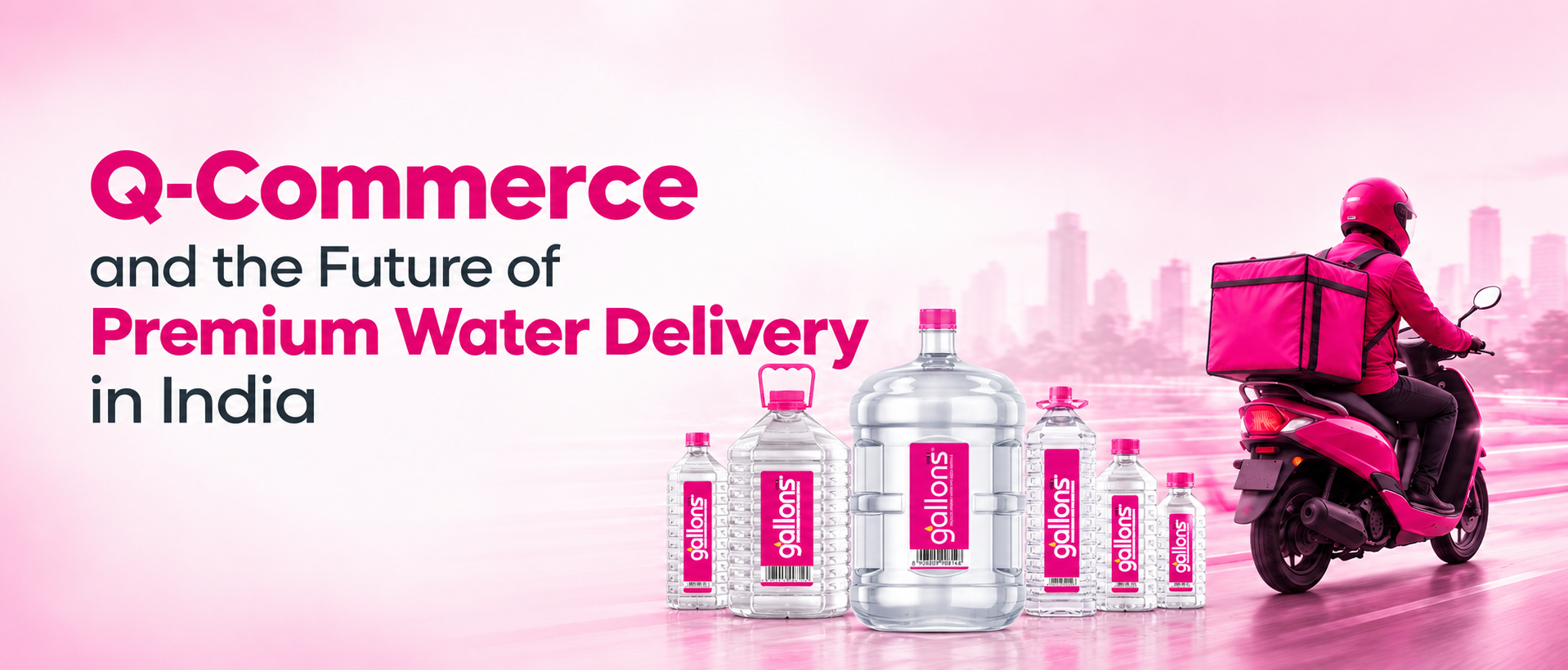
Q-Commerce and the Future of Premium Water Delivery in India
How platforms like Blinkit and Instamart are reshaping how urban India buys water, and why brands must adapt.
Waiting Has Become Unacceptable. And That Changes Everything.
There is a moment that defines a generation's relationship with convenience
For previous generations, it was the arrival of home delivery, the idea that you did not have to leave your house to get something. For India's urban millennial and Gen Z consumers, the standard has shifted again, and this time, the expectation is not just delivery. It is delivered in minutes.
India's quick commerce market recorded a gross order value of ₹64,000 crore in FY 2025, more than double the previous year. It now accounts for nearly two-thirds of all e-grocery orders in urban India. By FY 2028, it is projected to reach ₹2 lakh crore. The sector has grown at a CAGR of over 71% between 2020 and 2024, a pace of expansion that has no parallel in Indian retail history.
This is not a channel experiment. This is a permanent behavioural shift, and for brands in the packaged drinking water industry, it is the single most consequential distribution change of the decade
How Quick Commerce Actually Works, And Why It Is Different
To understand why Q-commerce changes things for water brands, you first need to understand what makes it structurally different from traditional retail or even scheduled e-commerce
The entire model is built around dark stores, small, compact, dedicated micro-fulfilment centres placed within 2 to 3 kilometres of residential zones in urban areas. These are not supermarkets. They are not warehouses. They are purpose-built, technology-managed inventory hubs that exist for one reason only: to fulfil online orders in 10 to 20 minutes
Unlike a kirana store or a supermarket shelf, a dark store carries no walk-in customers. Every square centimetre of space is dedicated to storage, picking speed, and order accuracy.
AI-driven demand forecasting tells the store exactly which SKUs to stock and in what quantity, based on real-time consumption patterns from that specific locality.
Currently, Blinkit, Swiggy Instamart, and Zepto collectively operate over 1,200 dark stores across major Indian cities, and that number is growing aggressively every quarter. Blinkit alone commands over 50% market share in the Q-commerce space. Swiggy Instamart holds 27%, and Zepto 21%. Amazon now entered with Amazon Now in 2025, and Flipkart Minutes is scaling rapidly, meaning the competitive pressure on dark store density and category breadth is only intensifying.
For consumers, the experience is frictionless: open an app, find what you need, confirm payment, and receive it before the next meeting starts. For brands, this means something far more significant: the distribution game has changed entirely
The Urban Consumer Who No Longer Plans
Understanding the Q-commerce revolution requires understanding who is driving it and why
The typical Q-commerce user in India is a millennial or Gen Z consumer between 18 and 44 years old, from an affluent urban household earning above ₹12 lakh annually, living in a metro or Tier-1 city. As of July 2025, quick commerce platforms serve 33 million monthly transacting users across 150+ Indian cities.
What defines this consumer is not just where they shop, but how they think about shopping.
Research published using data from 1,200 consumer surveys and over 20,000 user reviews found that speed and convenience are driving emotionally charged, often impulsive purchasing decisions among Q-commerce users. These consumers have internalised instant availability as the default. They do not maintain a weekly grocery list for bulk replenishment. They order when they run out, when they think of it, when they need it now.
For packaged water specifically, this creates a behaviour pattern that traditional retail never captured: the immediate-need order. Someone running low on bottles at home at 9 PM does not drive to a store. They open Blinkit. Someone hosting guests unexpectedly does not plan a shopping trip. They open Instamart. A family in peak summer running through water faster than expected does not wait until the next scheduled delivery. They ordered on Zepto and have 6 bottles at the door before the next hour.
This is consumption behaviour that simply did not exist as a channel five years ago. And it is now the primary way millions of urban Indians access packaged water.
What This Means for FMCG Brands, And Specifically for Water
The scale of Q-commerce's impact on FMCG is no longer theoretical. The numbers document it clearly.
Quick commerce now accounts for nearly 35% of FMCG e-commerce sales in India and is expanding at a 40%+ CAGR, making it the fastest-growing sales channel in urban India. Between FY 2022 and FY 2025, India's Q-commerce market grew by 280%. Major FMCG brands, Dabur, Nestlé, P&G, and L'Oréal have seen online sales double since joining Blinkit and Instamart. For beverage categories specifically, online RTD beverage sales in India grew by 52% year-on-year in 2024, with 57% of that growth coming directly from Q-commerce platforms.
For the packaged water category, the implications are layered.
- Reorder cycles have compressed dramatically: Where consumers previously bought water monthly or bi-weekly through traditional channels, Q-commerce users now reorder as frequently as every 5 to 7 days. This is not just higher frequency; it is a fundamentally different relationship with the product, one that rewards brand recall and consistent availability over price-led decision-making.
- The digital shelf has replaced the physical shelf: In a traditional kirana or supermarket, a water brand's position depends on physical shelf placement and distributor relationships. On a dark store platform, visibility is determined by search ranking, in-app placement, and category hero positioning. Brands that understand this are buying banner placements, sponsoring category slots, and investing in platform-specific visibility strategies. Advertisement spend on Blinkit, Zepto, and Instamart jumped from ₹1,325 crore to ₹4,000 crore in 2025 alone, a 202% surge in a single year, with projections of ₹6,000 crore by 2026.
- Premium commands a natural advantage: The Q-commerce buyer profile, affluent, urban, convenience-oriented, is exactly the consumer who chooses premium over mass. They are not price-comparing three water brands at the bottom of a search page. They are buying what they trust, quickly. Premium packaged drinking water brands with strong quality signals, clean packaging, and brand recognition are positioned to capture disproportionate value on these platforms compared to mass-market alternatives.
- Packaging and logistics requirements are different: Dark stores require compact, durable, fast-scanning packaging. Products need to be shelf-efficient for small dark store formats, resilient to fast last-mile delivery, and easy to scan with clear barcodes. A water brand that has not thought about its packaging in the context of Q-commerce logistics is operating with a meaningful disadvantage
The Kirana Disruption, And What It Means for the Industry
Quick commerce is not just growing; it is displacing traditional retail in urban India, and the scale of that displacement is becoming measurable.
The All India Consumer Products Distributors Federation reported that approximately 2 lakh kirana stores shut down in a single year due to the combined pressure of Q-commerce expansion and shifting consumer behaviour. These closures are concentrated in metro and Tier-1 cities, precisely the markets where packaged water consumption is highest and where premium water brands have traditionally built their core distribution.
For a water brand that built its urban distribution through kirana networks and modern trade, this represents a meaningful structural risk. Channels that were reliable a few years ago are contracting. The consumer who used to buy your water at the neighbourhood store now buys it on an app. If your brand is not on that app, you are not competing for that consumer; you have already lost them.
This is not a future risk. It is a present-tense distribution reality.
Tier-2 Is Next, And the Window to Get There First Is Open
Today, Q-commerce is concentrated in metros and Tier-1 cities. But the expansion trajectory is clear.
As of mid-2025, quick commerce platforms operate across 150+ cities. Blinkit, Instamart, and Zepto are all actively investing in dark store infrastructure in Tier-2 markets, Jaipur, Lucknow, Indore, Nagpur, Surat, Coimbatore, and Bhubaneswar. Amazon Now and Flipkart Minutes are building toward the same markets. The same urban, convenience-driven consumer that adopted Q-commerce in Delhi and Mumbai in 2021 is now the dominant consumer profile emerging in India's secondary cities.
For a water brand with manufacturing infrastructure already present across multiple states, as Gallons is, this Tier-2 expansion is not a distant opportunity. It is an immediate strategic window. Brands that establish a strong Q-commerce presence in Tier-2 markets before the channel consolidates will enjoy the kind of early-mover advantage that is extremely difficult to replicate once market positions harden.
Gallons Premium Water, Meeting India Where Its Behaviour Has Already Moved
At Gallons Premium Water, we have always believed that distribution is not just logistics; it is a statement about where your brand is willing to show up for its customers.
That is why Gallons is available on BigBasket and Swiggy Instamart, bringing premium hydration to urban consumers in under 30 minutes. Our presence on these platforms is not a marketing experiment; it is a recognition that the channel where urban India now buys its daily essentials is exactly the channel where a premium water brand with 14 manufacturing units and 12+ states of supply reliability belongs.
With a 12-stage purification process, 121-point quality check, and QR-code batch traceability, every bottle of Gallons that arrives at a customer's door via Q-commerce carries the same engineered purity guarantee as every bottle dispatched from our manufacturing facilities to any institution, hotel, or corporate office across India.
Because in Q-commerce, the consumer cannot pick up the bottle and read it on a shelf before deciding. They buy on trust, trust in the brand name, trust in the platform, and trust in the quality signal that a premium brand communicates through its positioning. Gallons is built to earn exactly that trust, on every platform, for every order.
What Brands in the Water Industry Must Do Now
The transition to Q-commerce-led urban distribution is not a choice brands get to make on a slow timeline. The market is moving, consumers have moved, and the window to establish platform presence before competitive positions solidify is narrowing.
For any brand in the packaged drinking water category, the strategic imperatives are clear.
Get listed, and get listed right. Presence on Blinkit, Instamart, and Zepto is not optional for urban brand relevance in India in 2026. Listing is just the entry point; the real work is optimising search placement, in-app visibility, and category positioning within each platform.
Invest in platform-native visibility. The digital shelf rewards investment. Brands that allocate marketing spend specifically toward Q-commerce platform advertising, category banners, hero slots, promotional deals tied to consumption moments, will build consumer recall that transfers across channels.
Design for the dark store. Packaging must be compact, durable, and scannable. A bottle designed for a supermarket shelf needs to be reconsidered for a 10-minute fulfilment environment where every second of picking time and every cubic centimetre of storage space matters.
Build for repeat purchase. Q-commerce drives short reorder cycles. Brands that deliver consistently on quality create automatic loyalty loops. The consumer who received a clean, fresh bottle of Gallons at 9 PM will be the same consumer who opens the app first the next time
Think Tier-2 now, not later. The first premium water brand to build a genuine Q-commerce presence in Tier-2 India will own a generation of consumers who are just now entering the digital buying habit
Get in touch with our corporate supply team today
Gallons Premium Water, Available on BigBasket and Swiggy Instamart | Premium Hydration Delivered in Under 30 Minutes | Engineered Purity, Every Drop, Every Order
FAQs
Neelesh Agrawal
Co-founder, Gallons · Sygnia Brandworks LLP
Neelesh co-founded Gallons in 2002 in Ahmedabad. He's spent the last two decades building plants, managing distribution networks, and writing about the operational side of the bottled water industry — the part the pitch decks don't cover.
More articles by NeeleshRelated articles.
Is Your Office Slowly Dehydrating Your Team's Performance?
The science behind how mild dehydration mirrors the cognitive effects of being legally drunk and what smart companies across India are doing about it.
How Technology Transformed India's Packaged Water Industry
From manual filling lines to 12-stage purification, QR-code traceability, and 1.5 lakh bottles per hour, the engineering behind modern water
Hydration and Hypertension: The Silent Connection Most Indians Ignore
With 220 million Indians living with high blood pressure, here's why daily water intake is your simplest cardiovascular habit.